Introduction
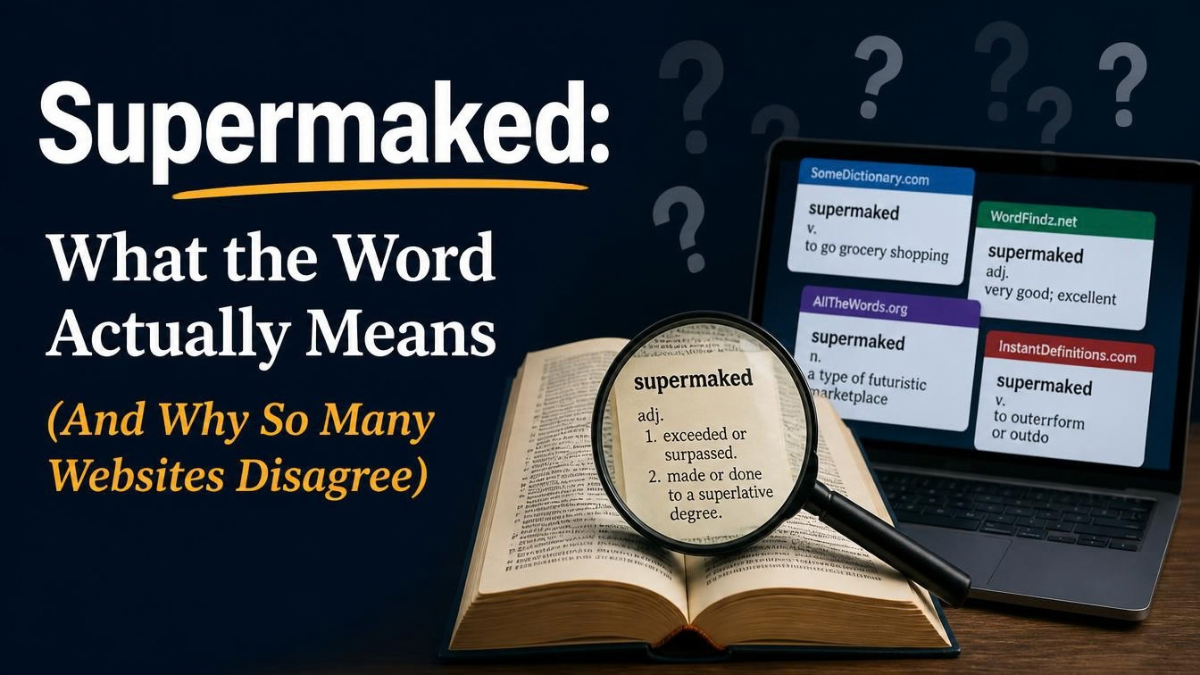
If you’ve searched “supermaked” recently, you’ve probably noticed something odd: nobody agrees on what it means. One article calls it a modern grocery concept. Another says it’s a European branding term for local markets. Another claims it’s some kind of digital-identity buzzword for creators. And buried in there, one or two pages just say it’s a typo.
They can’t all be right — and honestly, most of them are guessing. None cite a source. None seem to know where the word came from. They read like they were written to fill a page that ranks for the search term, not to actually answer the question.
So here’s the straight version: “supermaked” isn’t a word with an established meaning. It doesn’t appear in any dictionary, and there’s no real evidence it’s used as an industry term, brand, or concept anywhere. The most plausible explanation is the boring one — it’s a common typo for “supermarket,” since D and T sit next to each other on a phone keyboard.
Below, we’ll go through where the competing claims came from and why they don’t hold up.
The Quick Answer: Is Supermaked a Real Word?
No. “Supermaked” is not a word you’ll find in any dictionary, and it isn’t a verified company, app, or retail platform either. There’s no business filing, no product listing, no established brand using that name in any consistent way. What you’re seeing online is a patchwork of guesses.
The most likely explanation is the simplest one: “supermaked” is a spelling variant — almost certainly a typo — of “supermarket.” On a phone keyboard, the D and T keys sit close together, and it’s an easy slip to make while typing fast. Once enough people made that slip, search engines started registering it as a real query worth answering. And because there was search volume but no actual definition behind it, a wave of websites rushed in to fill the gap — each inventing its own explanation to try to rank for the term.
That’s the pattern worth understanding here: a typo created a search trend, and the search trend created content, and the content is now being mistaken for meaning. Here’s how that actually happened.
Where the Word “Supermaked” Comes From
The supermarket spelling-variant theory
The simplest explanation is a keyboard slip. “Supermarket” and “supermaked” differ by one letter swap — R and T become D — which lines up with how easy it is to mistype on a cramped mobile keyboard, especially while typing quickly or with autocorrect half-engaged. This theory doesn’t require any hidden meaning or clever branding story. It just requires people typing fast.
How search trends create “ghost keywords”
Here’s the part most explanations skip. Search engines don’t just index existing words — they also track what people are actively searching, typos included. Once enough people typed “supermaked” instead of “supermarket,” it started showing up in keyword-research tools as a term with real search volume. To a keyword tool, volume looks like demand. But demand for what? Nobody had actually defined the word yet. That’s a “ghost keyword” — a term that exists in search data without ever having existed in language. It’s a gap, not a definition.
A couple of sites using it as a store or brand name
To make things murkier, a small number of businesses — mostly local grocers, mainly in Europe — have used “Supermaked” as an actual store name, likely leaning into its resemblance to “supermarket” for easy recognition. Real, but narrow: a handful of storefronts, not an industry term.
The actual mechanism
Put the pieces together and the pattern is clear: a typo generated search volume, tools flagged that volume as valuable, and content sites — needing something, anything, to publish — filled the empty slot with speculative definitions. Once one site guessed “modern retail concept,” others copied and expanded the guess. Confusion didn’t just happen; it was manufactured, page by page.
What Different Websites Claim Supermaked Means
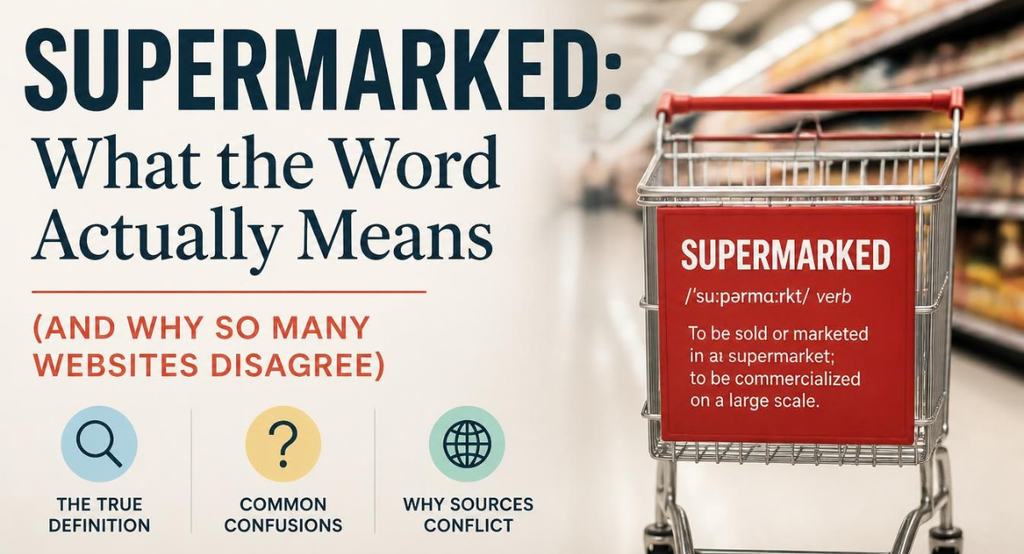
Once the ghost keyword existed, different sites needed different angles to fill it — and each landed somewhere slightly different depending on the topics they normally cover. Here’s a breakdown of the four main claims circulating, and why none of them holds up as an actual definition.
A modern grocery retail concept
This version leans on retail buzzwords: efficient store layouts, better product organization, smarter shelf placement, and digital tools that speed up checkout. It’s vague by design — general enough to sound plausible for any grocery-adjacent search, but specific to nothing. No named stores, no case studies, no verifiable examples of this “concept” actually being implemented anywhere.
An AI-powered smart store
A tech-flavored variation, this one folds in cashierless checkout, personalized recommendations, and automated inventory tracking — essentially describing existing technologies (like Amazon Go-style systems) and slapping the word “Supermaked” on top. There’s no evidence tying the term to any specific AI retail platform or company building this.
A European grocery brand
This is the one claim with a sliver of truth behind it — a small number of independently run grocery stores, mostly in Europe, have used “Supermaked” as a business name. But a handful of local storefronts isn’t the same as an established retail brand or franchise, and most articles using this framing stretch a narrow fact into a much bigger claim than it supports.
An online grocery delivery service
The least-supported claim of the four. There’s no app listing, no delivery platform, and no company registry entry matching this description under the name “Supermaked.” This version appears to be filling in a gap with whatever’s currently trending in grocery tech coverage — delivery apps — rather than reporting anything specific to the term itself.
The contradiction, side by side:
| Claim | What it says Supermaked is | Verifiable evidence |
| Modern retail concept | A layout/efficiency philosophy | None found |
| AI-powered smart store | A tech-driven automated store | None found |
| European grocery brand | A small local store name | Partial — a few real stores |
| Delivery service | An online grocery app | None found |
Four sources, four different categories of business — a physical store, a tech platform, a brand, and an app. If “Supermaked” had a real, agreed-upon meaning, these wouldn’t be describing entirely different kinds of things. That’s not nuance. That’s the absence of a definition.
What Supermaked Is NOT
To be clear about the boundaries here: “Supermaked” has no Wikipedia entry, no listing in any business registry that ties it to a single verified company, and no coverage from established news outlets. Nothing in mainstream retail journalism — the sources that would normally cover a genuine new grocery chain, tech platform, or retail concept — mentions it at all.
There’s also no single confirmed owner, no headquarters, no founding date, and no launch announcement anywhere. Every article claiming otherwise stops short of naming any of these details, which is itself a signal. A real company or product almost always leaves some kind of paper trail — a press release, a registration filing, an investor mention, a founder’s LinkedIn post. “Supermaked” leaves none.
That absence matters. When a website describes something in confident, specific-sounding language — features, benefits, a whole “how it works” section — without ever citing where that information came from, treat it as a red flag rather than reassurance. Confidence isn’t the same as verification, and in this case, the confidence was built entirely on guesswork.
Did You Mean “Supermarket”? Here’s What’s Actually Trending in Grocery Retail
If a typo brought you here, let’s redirect to what’s actually happening in grocery retail — real trends, backed by real data.
Self-checkout and cashierless stores
Computer-vision checkout is now moving from pilot programs into real store deployments, with point-of-sale companies building AI-driven loss-prevention and self-checkout tools around it. The goal: shorter lines, faster exits.
Grocery delivery apps
Delivery isn’t new anymore — it’s maturing. Growth continues, but the real story in 2026 is execution: retailers refining fulfillment and partnerships as competition intensifies, rather than racing to launch new apps.
AI-based inventory and personalization
This is where the biggest shift is happening. AI has moved from background forecasting to active, real-time store operations — managing restocking to cut overstock and adjusting prices dynamically to reduce food waste. On the shopper side, most people now use AI somewhere in their shopping process, mainly to save money and shop faster, though few trust it to make purchases on their own. Nearly all grocers are experimenting with AI in some form, focused on inventory, checkout speed, and reporting accuracy.
None of this needed a made-up term to describe it. These are real, documented shifts at real companies — the opposite of a search-volume mirage with no substance behind it.
Could “Supermaked” Work as a Business or Brand Name?
Setting the confusion aside, there’s a practical question buried in all this: is “Supermaked” actually usable as a business name? For entrepreneurs, that’s worth a straight answer.
Check before you commit
Domain availability and trademark status change constantly, so don’t take any article’s word for it — including this one. Search the exact name on your country’s trademark database and check domain availability directly before assuming it’s open. A few small grocers already use it, so availability may vary by region and industry class.
The upside
The name is short, easy to say, and close enough to “supermarket” that people grasp the category instantly. Because it’s not a common word, it’s less likely to compete for search ranking or trademark space with dozens of existing businesses — a genuine advantage for a new brand trying to stand out.
The downside
That same closeness to “supermarket” is also a risk. Customers may read it as a typo rather than a name, or assume autocorrect changed it when they see it written down. There’s also zero existing brand recognition — you’d be building trust from nothing, with a name that some people may initially distrust simply because it looks like a mistake.
It could work, but only with strong, consistent branding to make the spelling feel intentional rather than accidental.
Frequently Asked Questions
Is Supermaked a company?
No. There’s no verified business registration, headquarters, or founder tied to a single company by that name. A few independent local grocers use it as a store name, but that’s not the same as an established company.
Is Supermaked the same as a supermarket?
Not officially — but it’s very likely a typo for “supermarket,” since the letters involved sit close together on a mobile keyboard.
Why do I see different definitions of Supermaked online?
Because the term had search volume but no real meaning behind it. Websites rushed to fill that gap with guesses, and later articles borrowed from earlier ones — creating the appearance of consensus without any actual verification.
Is there an official Supermaked website?
There’s a website using the name, but it functions more like a content site than a verified company page — it doesn’t confirm ownership, headquarters, or business registration details.
Should I trust articles that define Supermaked confidently?
Be cautious. Confident, detailed-sounding claims aren’t the same as verified facts. If an article doesn’t cite a source for its definition, treat it as speculation — which is exactly how this term’s confusion started.
Conclusion
Supermaked isn’t a real word, a verified company, or an established concept — it’s almost certainly a typo for “supermarket” that picked up search volume and got filled in with speculation. The confident-sounding definitions floating around online were built on guesses, not sources.
The bigger lesson applies far beyond this one term: when you see a website define something with total confidence but no citation, no founder, no paper trail — pause before trusting it. Ghost keywords like this one are more common than people realize, and they spread fastest when readers assume confidence equals accuracy.
If you found this useful, explore more of our myth-busting explainers, or drop a comment with a term you’d like us to investigate next.