
Introduction
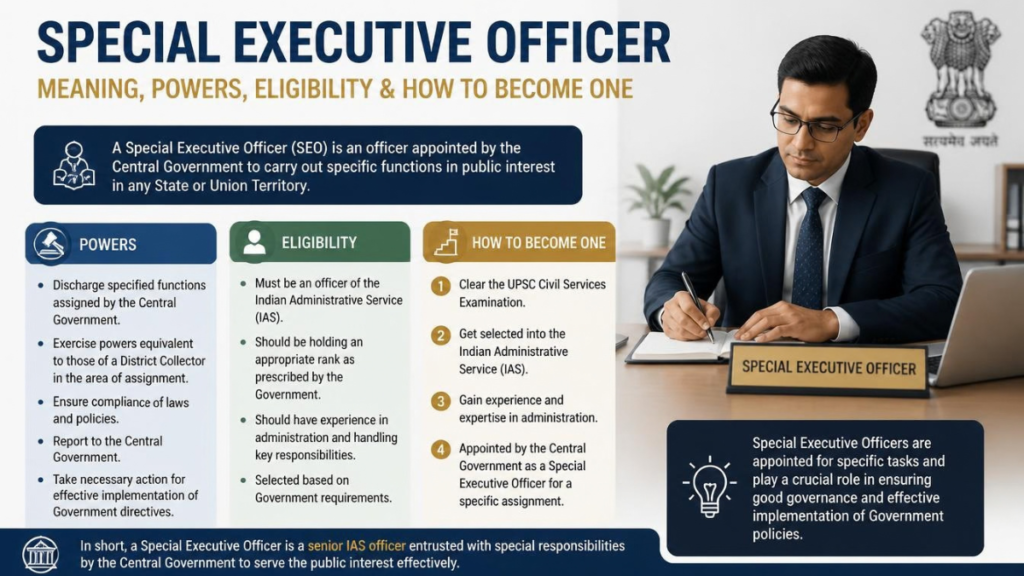
A Special Executive Officer (SEO) is a title used in two very different contexts. It can refer to a senior-level corporate or government official. Who’s given special executive authority to handle a specific function or project, or it can refer to what’s more accurately called a Special Executive Magistrate in India. A temporary judicial-type officer appointed to maintain law and order during specific events or emergencies.
Here’s where a lot of confusion starts: people online use these two meanings almost interchangeably. But they’re really not the same thing at all. One is a corporate/administrative role tied to organizational authority and decision-making, while the other is a legal appointment under India’s criminal procedure system. One that hands citizens or officials the job of handling public order duties on a temporary basis. Knowing which one you’re actually looking for makes a big difference in understanding the powers, eligibility, and responsibilities that come with the title.
This term shows up in a lot of different searches — job seekers checking out a position. They’ve been offered, students studying for competitive or law exams. HR professionals drafting job descriptions, and even business owners trying to understand governance structures. Whatever brought you here, this guide breaks down both meanings clearly, so you’ll know exactly what a Special Executive Officer is. What they can (and can’t) do, who qualifies for the role, and how it actually works in practice.
What Is a Special Executive Officer? (Quick Definition)
In plain English, a Special Executive Officer is someone given extra authority — either administrative or legal — to carry out a specific set of duties that go beyond a typical job role. The exact meaning, though, depends entirely on where and in what context you’re hearing the term used.
In the corporate or government world, it usually refers to a senior professional who’s been granted special decision-making powers. Often for a particular project, department, or crisis situation. Think of it as a title that says: this person has been given authority to act on behalf of leadership in this specific area.
In India, however, the term is most commonly linked to the Special Executive Magistrate (SEM). A completely different kind of role. This is a legal appointment, not a corporate one, and it’s given to select citizen. (often retired officials, lawyers, or respected community members) to help maintain public order during events like festivals, protests, or elections.
And then there’s a third, related term that often gets mixed into the conversation. The Special Police Officer (SPO), who is a private citizen temporarily given limited police powers to assist law enforcement. Usually during a specific emergency or security situation.
Which Meaning Applies to You?
| Aspect | US Corporate/Government SEO | Indian Special Executive Magistrate | Special Police Officer (SPO) |
| Nature of role | Administrative/business authority | Judicial/quasi-judicial appointment | Law enforcement assistance |
| Who appoints | Company leadership or government department | District Magistrate / State Government | Police department or state government |
| Duration | Ongoing or project-based | Temporary (usually 1–3 years, renewable) | Temporary, event/emergency-based |
| Core power | Decision-making within assigned scope | Maintain public order, issue orders under CrPC | Assist police, limited arrest/enforcement power |
| Typical use case | Corporate governance, special projects | Festivals, protests, elections, emergencies | Crowd control, local security support |
| Legal backing | Company bylaws/employment contract | Code of Criminal Procedure (India) | State Police Acts |
If you’re a job seeker or HR professional in the US, you’re almost certainly dealing with the first meaning. If you’re a student, law aspirant, or reading about Indian civil administration, it’s the second. And if you’ve come across the term in a policing or security context, it’s likely the third.
Special Executive Officer Meaning in the US Corporate & Government Context
In the US, the term Special Executive Officer doesn’t come from one single, standardized legal definition the way it does in India. Instead, it’s more of a functional title — used to describe someone operating outside the normal chain of command, brought in (or promoted) to handle something specific. That something specific usually falls into one of two tracks: government administration or private corporate governance.
The Federal Administrative Track (Special Government Employees)
On the government side, this concept overlaps closely with what’s officially called a Special Government Employee (SGE). A real, defined classification under US federal law. An SGE is someone who works for a federal agency for a limited period, typically no more than 130 days in a 365-day stretch, usually because they bring specialized expertise that the agency doesn’t have in-house.
These individuals aren’t full-time bureaucrats. They’re often industry experts, scientists, academics, or consultants who get pulled in temporarily to advise on a specific issue, sit on a review board, or help push through a particular initiative. Because they’re technically government employees during that period, they’re also subject to certain ethics rules and conflict-of-interest restrictions — even though their involvement is short-term.
So when someone uses the phrase “Special Executive Officer” in a federal or public-sector context, they’re often informally describing this kind of temporary, expertise-driven appointment, even if Special Government Employee is the more accurate legal term.
The Private Corporate Track (Board-Appointed Specialists)
In the private sector, the title works a bit differently. Here, a Special Executive Officer is usually someone appointed directly by a company’s board of directors or senior leadership to handle a defined, high-stakes responsibility — something that doesn’t fit neatly into the existing management structure.
This could mean overseeing a merger, leading a restructuring effort, managing a crisis (like a major lawsuit, data breach, or PR emergency), or spearheading a new business unit. Because the role is created around a specific need rather than a standard job description, the person holding it often reports directly to the board or CEO, bypassing the usual layers of middle management.
It’s a title you’ll see more often in larger corporations, especially during periods of transition, expansion, or damage control — situations where leadership needs someone with clear authority to act fast, without getting tangled in normal approval chains.
Why the Role Is Special (Time-Limited, Project-Specific, Non-Standard Hierarchy)
The word special isn’t just a fancy add-on to the job title — it actually tells you a lot about how the role functions. Three things generally make it special:
It’s time-limited. Unlike a regular executive position, this role usually has a shelf life. It exists to solve a problem or complete a project, and once that’s done, the position often dissolves or the person moves back into a standard role.
It’s project-specific. The authority granted isn’t broad — it’s scoped tightly around one issue, initiative, or crisis. A Special Executive Officer handling a merger, for example, likely has no say over unrelated departments like marketing or HR.
It sits outside the normal hierarchy. Instead of climbing up through several layers of approval, this person typically answers directly to top leadership. That’s what allows them to make faster decisions — but it also means their authority is usually temporary and clearly boxed in, rather than a permanent seat of power within the company.
In short: it’s a title built for flexibility, not permanence — designed to give someone real authority exactly where and when it’s needed, without reshaping the entire organizational chart.
Special Executive Officer Powers
The powers that come with this title change quite a bit depending on which track you’re looking at — public sector or private corporate. What stays the same, though, is the idea that these powers are always tied to a specific purpose, not open-ended authority to do whatever the person wants.
Powers in the Public Sector
When we’re talking about the government/administrative side (like Special Government Employees). The powers granted usually revolve around advisory influence and decision input, rather than direct command authority. This typically includes:
- Advising on policy or technical matters within their area of expertise, often as part of a committee, task force, or review board
- Reviewing proposals, applications, or projects and providing recommendations that influence final government decisions
- Representing the agency in specific meetings, negotiations, or public forums related to their assigned task
- Accessing certain confidential or sensitive information needed to do their job — though this comes with strict ethics and disclosure obligations
What they generally don’t get is unchecked authority to make binding decisions alone. Their input feeds into a larger decision-making process, but the final call usually still rests with permanent agency leadership.
Powers in the Private/Corporate Sector
On the corporate side, the powers tend to be more direct and action-oriented. Since the whole point of the role is to get something specific done quickly. Common powers include:
- Making executive decisions within the defined scope of their project or crisis. (e.g., approving budgets for a specific initiative, signing off on vendor contracts related to their task)
- Directing teams or departments temporarily assigned to support their project, even if those teams don’t normally report to them
- Representing the company in negotiations, legal matters, or public statements tied to their specific responsibility
- Bypassing standard approval layers for decisions within their scope, since they typically answer directly to the board or CEO
This is what makes the role valuable to companies. It cuts through red tape during situations where speed and clear accountability matter more than following the usual chain of command.
What They Cannot Do (Scope Limitations)
Regardless of which sector we’re talking about, there are clear boundaries on what a Special Executive Officer can actually do. These limitations exist precisely because the role is designed to be narrow and temporary, not a substitute for permanent leadership. Generally, they cannot:
- Make decisions outside their assigned scope — a person brought in for a merger can’t suddenly start making calls about unrelated departments
- Hold the position indefinitely — once the project ends or the term expires, the special authority typically ends with it
- Override core governance structures — in the corporate world, they still answer to the board; in government, they still operate within federal ethics and oversight rules
- Act with zero accountability — especially for Special Government Employees, there are strict conflict-of-interest and disclosure rules that limit how they can use their position, particularly if it overlaps with their private-sector interests
- Replace standard legal or compliance processes — even with expanded authority, they still have to work within existing laws, contracts, and regulatory requirements
Basically, the power is real, but it’s a scoped, borrowed kind of authority. Given for a purpose, and expected to stay within those lines.
Special Executive Officer Eligibility & Qualifications
Since this isn’t a role with one fixed job description, there’s no single checklist that applies everywhere. That said, there are some common patterns in what qualifies someone for the position, who actually appoints them. and how long the appointment tends to last.
Education and Experience Requirements
There’s no universal degree or certification required to become a Special Executive Officer — the requirements shift depending on the field and the specific task at hand. That said, a few common threads show up again and again:
- Deep subject-matter expertise is usually non-negotiable. Whether it’s a legal expert, financial specialist, engineer, or industry veteran, the person needs to bring knowledge the organization doesn’t already have in-house.
- A strong professional track record matters more than a specific degree. Most people stepping into this kind of role already have years of relevant experience — often in senior or specialized positions.
- Relevant certifications or licenses may be required depending on the task. For example, someone handling legal or compliance matters would likely need a law background, while a financial restructuring role might call for a CPA or similar credential.
- For government-related appointments, there’s often an added layer of vetting — background checks, conflict-of-interest disclosures, and sometimes security clearances, especially if the role involves sensitive information.
Basically, the problem the organization is trying to solve shapes the education and experience needed — not some standardized entry requirement.
Who Appoints a Special Executive Officer
The appointing authority also depends heavily on context:
- In government settings, appointments are typically made by the head of the relevant agency or department. Since these roles often fall under the Special Government Employee classification, the agency is responsible for vetting the person and ensuring they meet federal ethics requirements before bringing them on.
- In the corporate world, the appointment usually comes from the board of directors or CEO/senior leadership, especially when the role is tied to something high-stakes like a merger, restructuring, or crisis response. Because the person will often bypass normal management layers, the decision to appoint them typically needs sign-off from the top.
- In some cases, especially in larger organizations, an executive committee or a specific department head with delegated authority might make the appointment, depending on internal governance rules.
In short: whoever holds the ultimate decision-making power in that organization — whether that’s a government agency head or a company’s board — is usually the one who signs off on bringing in a Special Executive Officer.
Appointment Term, Renewal, and Revocation
Because this role is built to be temporary and purpose-driven. the way appointments start and end tends to follow a fairly predictable pattern:
- Fixed or project-based terms: Most appointments are tied to either a set time period or the completion of a specific project — whichever comes first. For Special Government Employees, there’s a hard federal cap of 130 days of service within a 365-day period.
- Renewal is possible, but not automatic: If the project extends longer than expected, or if new needs arise, the appointment can often be renewed or extended. but this usually requires fresh approval from whoever appointed the person in the first place.
- Revocation can happen at any time: Since the role exists to serve a specific purpose, it can be ended early if that purpose changes, if the project is cancelled, or if the person is found to have violated ethics rules, company policy, or the terms of their appointment.
- No automatic path to a permanent role: Serving as a Special Executive Officer doesn’t usually convert into a permanent position — once the assignment wraps up, the special authority typically ends, and the person either exits the organization or returns to a standard role.
This built-in flexibility is actually one of the biggest advantages of the role. Organizations get expert help exactly when they need it, without long-term commitments on either side.
How to Become a Special Executive Officer
There’s no single application portal or standardized exam for this role. Since it’s more of a purpose-built position than a traditional career path, “becoming” one usually happens through expertise, networking, and being in the right place when an organization needs specialized help. Still, there’s a general process that tends to play out on both the government and corporate sides.
Step-by-Step: Government Track
If you’re aiming for a Special Government Employee-type role, the path usually looks something like this:
- Build recognized expertise in a specific field. This is the foundation — agencies bring in outside help because they need knowledge they don’t already have internally, so a strong, specialized background is essential.
- Get noticed within your industry. This often happens through published research, industry leadership, conference speaking, advisory work, or simply being known as a go-to expert in your niche.
- Get identified or nominated by an agency. In most cases, government agencies reach out to experts directly, rather than accepting open applications. Being connected to the right professional or academic circles increases your chances of being considered.
- Undergo vetting and ethics screening. Once nominated, you’ll typically go through background checks, financial disclosures, and conflict-of-interest reviews to make sure your outside work doesn’t compromise your objectivity.
- Receive a formal, time-limited appointment. Once cleared, you’re brought on for a specific task, project, or advisory role — with the built-in understanding that it’s temporary, not a full-time government job.
- Fulfill the role within federal limits. Remember, this kind of appointment is generally capped at 130 days of service within a 365-day period.
Step-by-Step: Corporate Track
On the private-sector side, the path is a bit more flexible, but generally follows this pattern:
- Establish yourself as a specialist in a high-value area. This might be mergers and acquisitions, crisis management, restructuring, compliance, or another niche that companies often struggle to handle in-house.
- Build a track record of high-stakes results. Since companies are trusting this person with significant authority. They typically look for someone who’s already proven themselves in similar situations elsewhere.
- Get identified by leadership. This usually happens through executive networks, recommendations, consulting relationships, or being headhunted specifically for a known challenge the company is facing.
- Negotiate the scope and authority of the role. Because this position doesn’t follow a standard job description, the specific powers, reporting lines, and responsibilities are usually discussed and defined upfront with the board or CEO.
- Receive formal appointment from the board or senior leadership. This typically comes with a clear mandate — what the person is being brought in to do, and for how long.
- Execute the assignment with direct reporting access. Once appointed, the person usually operates with a level of authority and access that bypasses normal management layers, allowing them to act quickly.
Documents and Verification Typically Required
Regardless of which track you’re on, most appointments involve some form of documentation and vetting. Commonly required items include:
- Proof of professional credentials — degrees, licenses, or certifications relevant to the role
- A detailed resume or professional history showing relevant experience and past achievements
- Background checks — especially important for government-related appointments, and increasingly common in corporate roles involving sensitive information
- Conflict-of-interest disclosures — particularly critical for government appointments, where outside financial interests need to be reported and reviewed
- References or professional endorsements from previous employers, clients, or industry contacts
- Signed appointment agreements or contracts outlining the scope, duration, authority, and terms of the role
- Security clearance (if applicable) — required for certain government roles that involve access to classified or sensitive information
Since the role is built around trust and authority, organizations tend to verify candidates thoroughly. They want to be confident the person they’re empowering actually has the expertise and integrity to handle the responsibility.
Special Executive Officer vs. Related Titles (Comparison Table)
With so many similar-sounding titles floating around, it’s easy to mix them up. Here’s a clear side-by-side breakdown of how a Special Executive Officer differs from each of these related roles.
| Title | Core Nature | Scope of Authority | Duration | Key Difference from SEO |
| Special Executive Officer | Purpose-built, expertise-driven role | Narrow, project/task-specific | Temporary, tied to project or term limit | Baseline for comparison |
| Executive Officer | Standard leadership position within an organization | Broad, ongoing operational authority | Permanent/ongoing | Not tied to a specific project — handles regular, continuous business operations |
| Senior Executive Officer (SEO) | Standard high-level management title | Broad, department or company-wide | Permanent/ongoing | A regular career-track leadership role, not a temporary special appointment |
| Special Police Officer | Citizen temporarily given limited law-enforcement powers | Narrow, enforcement/security-related only | Temporary, event or emergency-based | Powers are specifically law-enforcement related, not administrative or business-related |
| Special Executive Magistrate (India) | Judicial/quasi-judicial appointment under Indian law | Narrow, public order and legal duties | Temporary, usually 1–3 years (renewable) | Legal/judicial authority under the Code of Criminal Procedure, not corporate or advisory in nature |
The quickest way to tell these apart: if the role involves ongoing, broad leadership over a business or department, it’s a regular Executive Officer or Senior Executive Officer. If it involves law enforcement-style powers given to a private citizen, it’s a Special Police Officer. And if it’s a legal appointment tied to India’s criminal procedure system, it’s a Special Executive Magistrate. A true Special Executive Officer, on the other hand, sits in its own category. A temporary, high-authority role created around a specific need, usually in a corporate or government advisory capacity.
Special Executive Magistrate (India) — The Other Common Meaning
Let’s switch gears now and talk about the Indian legal meaning of this term. This is actually the version a lot of people are searching for — especially law students, government job aspirants, and anyone trying to understand how local law and order works in India.
Legal Basis: CrPC Section 21 → BNSS Section 15
This role isn’t just an informal title. It’s backed by actual law.
It originally came from Section 21 of the Code of Criminal Procedure (CrPC), 1973. This section allowed State Governments to appoint Executive Magistrates for a specific area or a specific job, and call them Special Executive Magistrates.
In 2023, India replaced the old CrPC with a new law called the Bharatiya Nagarik Suraksha Sanhita (BNSS). The same rule now exists under Section 15 of the BNSS. The idea is basically the same, but with one big change: the new law clearly allows senior police officers to be appointed to this role too — something that wasn’t as common before.
In short: the State Government can pick someone, give them a fixed time period or a specific task, and hand them magistrate-level powers for that job.
Who Can Be Appointed
The law keeps this fairly open. A Special Executive Magistrate can be:
- A regular Executive Magistrate, given one extra, specific task or area
- Any police officer of the rank of Superintendent of Police or higher — this is the newer, more debated option
- Appointed for a set time period, decided by the State Government
- Appointed for a specific area (like a sensitive neighborhood) or a specific event (like a festival, election, or public gathering)
Before this police-officer option became common, this role usually went to retired government officials, revenue officers, or respected local citizens. That older pattern is still used in many states today, alongside the newer trend of appointing serving police officers.
Real Example — Maharashtra Assistant Commissioners of Police Notification
This isn’t just a theory — it actually happens in real government orders.
Back in 1974, Maharashtra appointed all Assistant Commissioners of Police in Greater Bombay as Special Executive Magistrates. This was challenged in court. The Bombay High Court initially said these officers couldn’t use full Executive Magistrate powers. But the Supreme Court overturned that decision in State of Maharashtra v. Mohammed Salim Khan (1990). The Court said Special Executive Magistrates do get the same powers as regular Executive Magistrates — because appointing them without real authority would make the whole system pointless.
This pattern continues today. In September 2024, Maharashtra issued a fresh notification under the new BNSS law, appointing Assistant Commissioners of Police across all police commissionerates (and Tehsildars in other areas) as Executive Magistrates. So this isn’t a one-time thing — it’s a regular part of how Indian states run local administration.
The Controversy: Police Officers Holding Magistrate Powers
Here’s where things get tricky.
India’s Constitution (under Article 50) says the police and the judiciary should stay separate. The people who investigate crimes shouldn’t also be the ones deciding punishments — that’s supposed to be a judge’s job, not a police officer’s job. When one person does both, critics say it creates a serious conflict of interest.
This exact issue came up in Tamil Nadu. In 2013 and 2014, the state gave Deputy Commissioners of Police the power to act as Executive Magistrates under certain CrPC sections dealing with preventive detention. In 2023, the Madras High Court cancelled these orders. The court said this setup was unfair, broke the rule of separating police and judicial power, and basically let the police judge people they were also policing. The judges even warned that mixing police work and judicial power like this leads to what they called executive anarchy.
And this debate is still ongoing. In late 2025 and into 2026, the same court put a hold on a new Tamil Nadu order that tried to give police officers similar magistrate powers under the new BNSS law.
Bottom line: The law does allow police officers to become Special Executive Magistrates. But courts in several states keep pushing back when this starts to look like the police getting to judge their own cases. This legal debate isn’t settled yet, and it’s likely to keep coming up as more states use this option.
Is a Special Executive Officer Role Paid or Honorary?
Short answer: it depends entirely on which version of the role we’re talking about. There’s no single, universal answer here, and that’s actually one of the most common points of confusion.
In the corporate world, this is a paid position. Since a Special Executive Officer is brought in by a company’s board or leadership to handle something big — like a merger or a crisis — it’s treated like any other high-level executive assignment. The person is compensated, often quite well, because they’re taking on serious responsibility and risk.
In the US government/federal context, Special Government Employees are also paid, though usually not at a full-time executive salary. Since their work is short-term and advisory, compensation is often lower than a permanent role, and sometimes it’s structured as a stipend or consulting fee rather than a regular salary.
In India, this is where it gets more mixed. When a serving police officer or an existing Executive Magistrate is appointed as a Special Executive Magistrate, there’s no separate salary for it. It’s simply an extra responsibility added on top of the job they’re already being paid for. But when a private citizen is appointed to a similar-sounding role — like Maharashtra’s local “Special Executive Officer” appointments, often given to respected community members or award recipients — it’s usually honorary. These citizens don’t receive a salary; the position is more about recognition and community service than income.
One important caveat: none of this is fixed across the board. Whether the role is paid, honorary, or something in between really comes down to the specific country, state, organization, or government department making the appointment. There’s no universal pay scale or standard figure you can point to — always check the specific notification, contract, or company policy tied to the exact appointment you’re looking into.
Common Misconceptions About the Role
Because this term gets thrown around so loosely online, a few misunderstandings keep popping up. Let’s clear them up.
Misconception #1: It’s one single, universal job title.
It’s not. As we’ve covered throughout this guide, the Special Executive Officer isn’t a fixed, standardized position with one set definition. It changes meaning depending on where you encounter it — a corporate authority role, a US federal advisory position, or India’s Special Executive Magistrate. Treating it as one uniform job title is probably the single biggest source of confusion around this term.
Misconception #2: It’s automatically a law-enforcement position.
Not necessarily. This mix-up usually happens because people confuse the term with the Special Police Officer, which genuinely does involve law-enforcement duties. But a Special Executive Officer — whether in the corporate world or as an Indian Special Executive Magistrate — isn’t inherently about policing. Even in India, where the role can carry legal authority (like maintaining public order or issuing preventive orders), it’s still an administrative/executive function, not a policing one — even when it’s a police officer holding the title.
Misconception #3: It’s a permanent position.
This is a big one. Across almost every version of this role — corporate, government, or Indian legal — the position is designed to be temporary and purpose-driven, not a permanent career post. It exists to handle a specific task, project, or time-bound need, and once that’s done, the special authority usually ends too. Holding this title doesn’t automatically lead to a permanent seat of power within the organization or government body that appointed you.
Understanding these three points alone clears up most of the confusion people run into when researching this role — it’s flexible by design, not fixed, not inherently law-enforcement, and not built to last forever.
FAQs
What is the exact Special Executive Officer meaning in simple terms?
Someone given extra, specific authority to handle a particular task or responsibility beyond their normal role — either a corporate specialist appointed for a project, or in India, a Special Executive Magistrate handling public order duties.
What are the primary statutory Special Executive Officer powers under law?
Under Section 15 of the BNSS (India), they can exercise the same powers as a regular Executive Magistrate — like handling public order, unlawful assemblies, and preventive action — but only within their assigned area or task.
What are the minimum Special Executive Officer qualifications required for appointment?
No fixed rule. Corporate roles need relevant professional expertise. In India, it’s usually an existing Executive Magistrate, a police officer of Superintendent rank or above, or in some states, a vetted private citizen.
Is a Special Executive Officer a government employee?
Sometimes. A US Special Government Employee is technically a temporary government employee. In India, it depends — if the person is already a police officer or magistrate, yes; if they’re a private citizen given an honorary title, no.
Is the role paid or honorary?
Corporate and US federal roles are usually paid. In India, it’s honorary for private citizens, and unpaid (just an added duty) for officials who already hold a government post.
What’s the difference between a Special Executive Officer and a Special Executive Magistrate?
Special Executive Officer is a general term for task-specific authority. Special Executive Magistrate is a specific Indian legal position under Section 15 of the BNSS, with defined legal powers.
Can the appointment be revoked?
Yes. Since the role is temporary and purpose-based, it can end early if the task is complete, the need changes, or the person violates the terms of appointment.
Conclusion
At this point, it should be clear that Special Executive Officer isn’t a one-size-fits-all title — it’s a term that shifts meaning depending on where you encounter it. In the US, it usually points to a corporate specialist or a temporary government advisor brought in for a specific task. In India, it’s most often tied to the Special Executive Magistrate, a legal appointment focused on maintaining public order under the BNSS.
If you’re still not 100% sure which version applies to your situation, here’s a quick way to double-check: if you’re dealing with a business role, project, or government advisory position in the US, head back to the section on the US corporate and government context. If you’re researching law, exam prep, or public administration in India, the Special Executive Magistrate section has everything you need — from its legal basis to real notifications and ongoing court debates. And if you came across the term in a policing or security setting, that’s more likely the Special Police Officer, covered in the comparison table.
Whichever version brought you here, the core idea stays the same: it’s a title built around special, task-specific authority — not a permanent, one-size-fits-all position. Knowing the context is really all it takes to understand exactly what powers, eligibility, and responsibilities come with it.